
April 2024: More FAFSA resources
Director’s note
Hello partners,
I was recently listening to Vox’s “Today, Explained” podcast, which dove deeper into the question that has been asked in several media stories lately: Is college worth it? While much of the debate wasn’t new, listening to student Jorge Vargas explain what goes into his post-high school decision-making was a good reminder that:
- College is, indeed, worth it, but the value students receive can vary depending on where they go and what they study.
- We can’t even begin to imagine all the factors that influence students’ decisions.
- But we can make sure they understand all their options, so they make the best decision for their future.
We’re taking important steps here in Washington state to help accomplish that last point. In fact, while this year’s FAFSA rollout has been a significant challenge for students and families this past year, so many of you are stepping up to ensure students have the support they need to complete the FAFSA (or WASFA) and design the future they want.
This newsletter highlights recent FAFSA updates we’re following and some important decisions our legislature made this year that should help more students explore postsecondary pathways. And, be sure to scroll down to read more about our four Horizons regional partnerships and a new dual credit resource created by the Gates Foundation’s U.S. Education Pathways team.
Thanks for your continued partnership!
Angela Jones
Director, Washington State and U.S. Charters
Four FAFSA things we’re following right now
While this year’s FAFSA rollout continues to impact students, families, and colleges, so many partners and community organizations are stepping up to help provide support. Here are four things we’re following right now about FAFSA outreach in Washington state:
1. Local support available: The College Success Foundation (CSF) is offering resources and other support to help local organizations with their FAFSA completion and outreach efforts.
- You can apply for a mini-grant to support your FAFSA/WASFA completion efforts.
- CSF also offers promotional materials and email templates that you can add your logo to and further customize.
2. Hearing from students: Julia Park, a news intern at Cascade PBS and a senior at the University of Washington, recently wrote about the FAFSA challenges Washington students are experiencing.
- Park also highlighted students’ continuing concerns about college costs.
- As student Sam Alvarado noted in the story, “A lot of my student peers are from low-income backgrounds, and college is something that has never even crossed their minds because they’re so concerned about tuition fees and everything.”
- Sam shared his story with legislators at a Gates Foundation event last November. We love seeing him advocate for students in our state!
3. Lessons from the Limitless Learning Network: Education First, who currently manages the Limitless Learning Network, shared four lessons from Better FAFSA. They highlight several ways local partnerships in Limitless are supporting students with FAFSA right now.
- For example, the Federal Way School District varied the time of their events to accommodate different family work schedules and provided bus transportation for after-school events.
4. New data dashboard: The Washington Student Achievement Council (WSAC) launched a data dashboard that highlights our state’s progress on educational attainment goals.
- WSAC used this new data dashboard to examine FAFSA completion rates for students eligible for Free or Reduced Priced Lunch (FRPL).
- While FRPL-eligible students are still filling out the FAFSA at lower rates, the gap is narrowing. For the Class of 2023, 48% of FRPL-eligible students completed the FAFSA compared to 55% of non-FRPL-eligible students. That gap was 11% in 2021.
Read more in The Seattle Times: WA students could forfeit thousands if they don’t submit a FAFSA
Policy wins for Washington students
Over the course of 60 days, legislators in Washington state passed several bills that will help more students explore postsecondary pathways and afford college.
Dual credit: Last year, Washington state eliminated fees for College in the High School, and enrollment in the dual credit program increased dramatically. In 2024, legislators agreed to budget increases and bills that will help more students explore this and other dual credit programs.
- As Washington STEM notes, legislators increased the budget this year — helping schools and colleges provide equitable access to these programs.
- Newly passed legislation will require schools to inform students and families about dual credit programs and the financial assistance programs available to reduce costs.
Financial aid: Students on the Supplemental Nutrition Assistance Program, or SNAP, will now automatically qualify for the maximum Washington College Grant award.
- Students can now receive funding through the state Washington College Grant, College Bound Scholarship, and Passport to Careers scholarship for six years instead of five.
- As Partnership for Learning explains, this simple change for recipients of SNAP could connect 30,000 more students to financial aid that can cover their entire college tuition in Washington state.
Data solutions: A new bill removed a data barrier to postsecondary opportunities by providing students with information about postsecondary and financial aid possibilities.
- The Office of the Superintendent of Public Instruction must share a directory of high school students with WSAC and public higher education institutions across the state.
- WSAC and public higher ed institutions may use that directory information to contact students to inform them about financial aid and postsecondary opportunities.
Maximizing the potential of dual credit
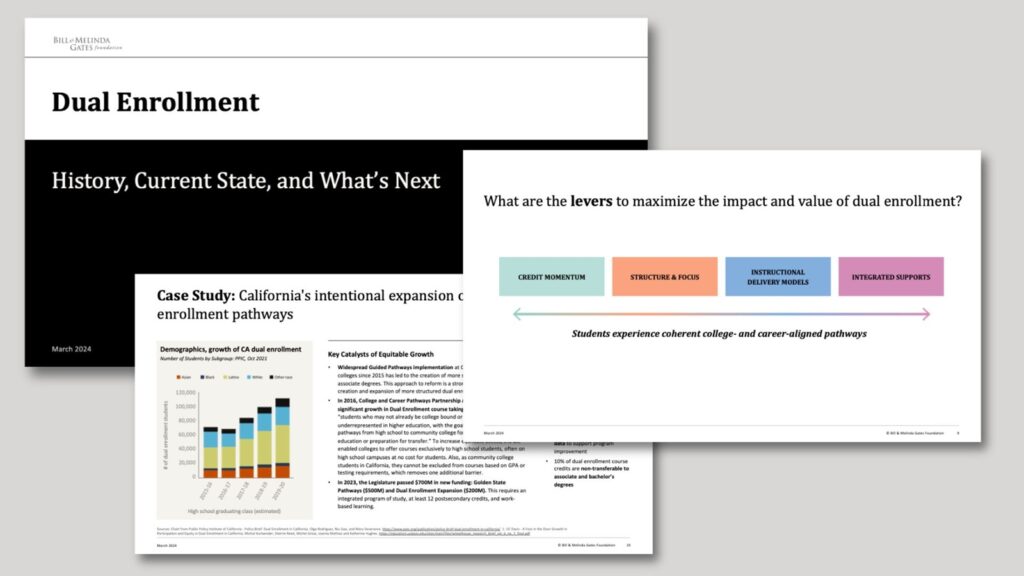
Dual credit programs in Washington state provide a meaningful boost to help students reach their postsecondary goals. However, our national Education Pathways team found that more needs to be done to strengthen these programs and make them available to more students.
- Alongside partners in the field, the Education Pathways team explored how dual credit — also called dual enrollment — can help students find paths that resonate with them and start building toward that future.
- They also examined how more students can become aware of dual enrollment resources, something we continue to explore in Washington state.
What they found: The Gates Foundation compiled our partners’ research into a single resource that highlights the knowledge we’ve gained while trying to answer some core questions about dual enrollment, including what great programs look like and what resources are needed to make all dual credit programs great ones.
Learn more: Maximizing the potential of dual enrollment
Horizons partners in the news
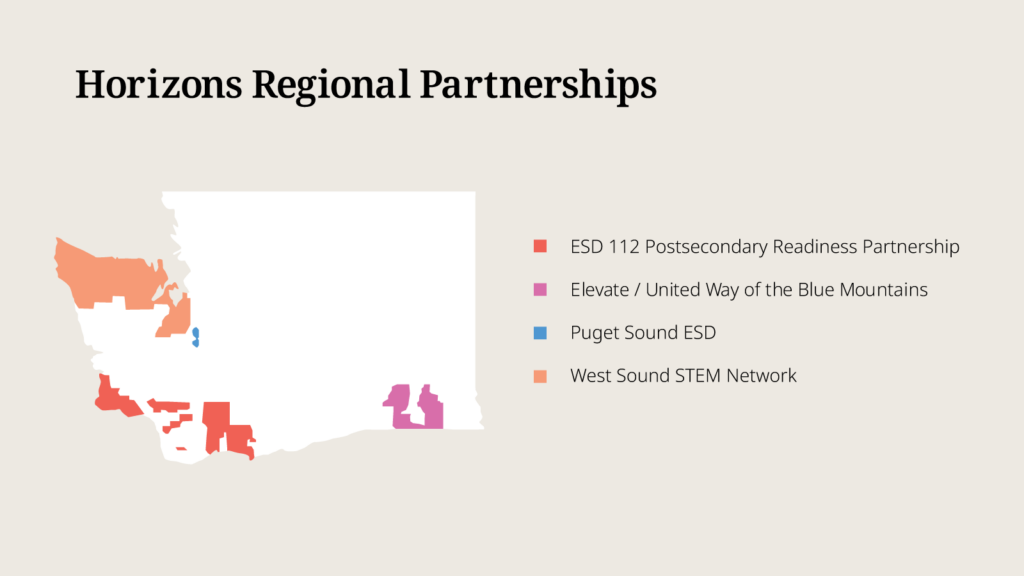
Earlier this month, we announced the four regional partnerships selected for our Horizons regional grant program. Read more about each region:
- The Columbian covered the goals of the Southwest Washington partnership led by ESD 112, including helping more students understand their postsecondary options.
- The Peninsula Daily News wrote about the Olympic and Kitsap peninsula partnership, which plans to add College Success Foundation advisors and help more students see the career options they can explore at their local colleges.
- The Walla Walla Union-Bulletin highlighted how the United Way of the Blue Mountains and partners are helping local students create plans for their post-high school lives.
- The Seattle Times noted that the Puget Sound ESD will focus on ideas that show promise in the Highline, Tukwila and Federal Way school districts.
- Plus, read about Washington STEM’s role leading the Horizons grants.
Congrats to our community and technical colleges!
Seven local community and technical colleges won Paragon Awards, which recognize outstanding achievement in design and communication. Congrats to the winners, who were announced at the 2024 national conference in Seattle!
- Bellingham Technical College for microsite/landing page and logo design
- Community Colleges of Spokane for digital advertisement (single or series)
- Green River College for podcast
- Renton Technical College for promotional video-short form
- Skagit Valley College for quick-turn video and communication success story/crisis communications campaign
- Tacoma Community College for promotional video-short form
- Whatcom Community College for television/video paid advertisement (series)